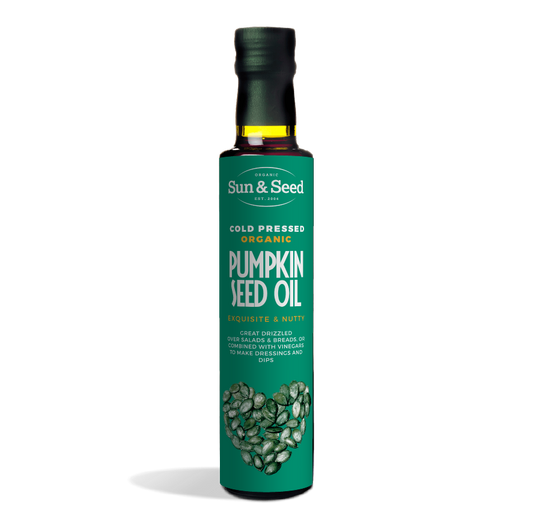
Our Organic Cold-Pressed Pumpkin Seed Oil is made from premium European pumpkin seeds, gently pressed at low temperatures. It is deep green and aromatic, with a smooth texture and a deep, nutty taste. Because it is a pure oil, its nutrition panel is short and easy to read once you know what each line means.
Nutrition per 100g
- Energy: 3700kJ / 900kcal
- Fat: 100g (saturates 10.4g, monounsaturates 45.7g, polyunsaturates 43.9g, trans fats 0g)
- Carbohydrate, sugar, protein and salt: 0g
What each figure means
Energy. Every gram of fat provides 37kJ (9kcal), which is more than twice the 17kJ (4kcal) in a gram of protein or carbohydrate. An oil that is 100% fat therefore works out at 3700kJ or 900kcal per 100g. In practice nobody eats 100g: a 10g drizzle over a salad is about 90kcal.
Fat. The 100g is the total. The reference intake printed on UK labels for an adult is 70g of fat a day, so a 10g drizzle is a seventh of that.
Saturates, monounsaturates and polyunsaturates. These describe the shape of the fatty acid chains. Saturated fats come mostly from animal foods such as butter and fatty meat (plus some plant oils such as palm and coconut), and the NHS advises adults to eat no more than about 30g a day (men) and 20g a day (women). Our oil has 10.4g of saturates in 100g, so a 10g drizzle contributes about 1g. Monounsaturates (the family that includes oleic acid, as in olive oil) and polyunsaturates (which include linoleic acid) make up the other 89.6g.
Trans fats, 0g. The label shows none, which is what you would expect of a single-ingredient oil that has only been pressed.
Zeros for carbohydrate, protein and salt. Oil is extracted from the seed, and the carbohydrate and protein stay behind in the press cake, which is why an oil can read as pure fat.
What is in the bottle, in more detail
Published analyses of cold-pressed pumpkin seed oil find that two fatty acids dominate: linoleic acid (a polyunsaturate) at around 45% and oleic acid (a monounsaturate) at around 38%, with smaller amounts of palmitic and stearic acids. One Polish study of cold-pressed pumpkin oils, comparing oil from unroasted seeds with oil from seeds roasted at 110°C, found that the fatty acid pattern did not change with roasting or with three months at room temperature. It also found that peroxide value, a measure of early oxidation, rose over those three months in both oils. That is the reason for our storage advice below.
Nutrition and health claims
Because more than 70% of the fatty acids in the oil are unsaturated (89.6g of the 100g by the figures above) and unsaturated fat provides more than 20% of the energy, the oil is high in unsaturated fat. That is the condition in the nutrition claims rules for using the wording. The authorised wording (Regulation (EC) No 1924/2006 and Regulation (EU) No 432/2012, as retained in Great Britain) is: "Replacing saturated fats with unsaturated fats in the diet contributes to the maintenance of normal blood cholesterol levels (MUFA and PUFA are unsaturated fats)."
Cold-pressed: what it means
The Codex Alimentarius standard for named vegetable oils defines cold pressed oils as oils obtained by mechanical procedures only, without the application of heat, and purified only by washing, settling, filtering and centrifuging. That differs from the traditional Austrian Styrian oil, whose ground seed paste is warmed and stirred before pressing, and the strength of the roasted flavour depends on how long that goes on. Ours skips that step and is simply pressed. It also takes a lot of seed: the Austrian agriculture ministry quotes roughly 2.5 to 3kg of seeds for each litre of oil, which is why pumpkin seed oil is a small-bottle ingredient rather than a cooking staple.
How to use it
- Drizzle over soups, roasted vegetables or pasta.
- Add to grain bowls, risotto and salads for an earthy richness.
- Swirl into dips or hummus.
- Pair with desserts, such as vanilla ice cream or roasted pears, for a bold contrast.
- Use it cold. Pumpkin seed oil pressed from whole seeds is thick and dark and has a low burning point, so it is not suited to frying.
Storage
Use within 3 months of opening and store cool and dry. Keep it in the dark too: in a study of commercial pumpkin seed oils kept at room temperature for 17 weeks, colour loss was far greater in light than in darkness. Screw the cap back on after each use.
Vegan and gluten-free. May contain traces of nuts and sesame seeds.

Sources
- Raczyk et al. (2017), Roasting pumpkin seeds and changes in the composition and oxidative stability of cold-pressed oils, Acta Scientiarum Polonorum Technologia Alimentaria
- Štrucelj, Rade and Mokrovčak (1998), Colour and keeping quality of pumpkin seed oil, pure and blended with other vegetable oils (abstract)
- FAO/WHO Codex Alimentarius, Standard for named vegetable oils
- Austrian Federal Ministry, Steirisches Kürbiskernöl (yield per litre)
- Product specification, Steirisches Kürbiskernöl g.g.A.
- Andres (2000), An Overview of the Oil Pumpkin, Cucurbit Genetics Cooperative
- NHS, Different fats in our diet
- Regulation (EU) No 1169/2011, Annex XIV (energy conversion factors)
- Regulation (EU) No 1169/2011, Annex XIII (reference intakes)
- Regulation (EC) No 1924/2006, Annex (nutrition claims)
- Regulation (EU) No 432/2012, Annex (authorised health claims)