Pistachios (Pistacia vera) are the seeds of a drought-tolerant tree that began in Central Asia and is now grown around the Mediterranean and beyond. They have one of the more unusual life stories of any nut.
Where pistachios began
A 2022 review of the archaeological and botanical evidence, published in Agronomy, places the wild stands of pistachio in southern Central Asia, northern Iran and northern Afghanistan. Pistachio shells turn up at sites in Uzbekistan, Tajikistan and Afghanistan, and the authors report continuous pistachio eating at the Kaynar Kamar rockshelter in Uzbekistan from the tenth millennium BC. These were wild nuts, gathered rather than farmed. The authors argue that cultivation began in southern Central Asia, and that the tree spread westward first.
The westward story is less tidy than the usual retellings. By the fourth century BC the Greek writer Theophrastus was describing the nut as a foreign curiosity, which suggests it was not yet known in Greece. Pliny the Elder claimed that pistachios reached Italy and Spain in the first century AD, and some sources repeat that the Romans brought the tree to Europe. The Agronomy authors point out that Pliny's information was largely second-hand, and that pistachio remains from that period have never been found in Italian archaeological contexts. In other words, the Roman link is plausible but unproven. What is clear is that pistachios were being grown in Syria by the first centuries AD, and that wider cultivation developed slowly.
A tree with separate sexes
Pistachio is dioecious: male and female flowers grow on separate trees. According to UC Davis material on pistachio production, orchards typically plant one male tree for every eight to 24 females. Pollination is by wind, not bees. EUFORGEN, the European forest genetic resources programme, notes that the species is well adapted to semi-arid, warm climates with hot, dry summers and cool winters, and that it is drought-tolerant.
Patience is required. Young trees take five to six years to produce nuts, and the crop alternates, with heavy years followed by light ones. That rhythm shows up in the famous pistachios of Bronte, on the slopes of Mount Etna in Sicily, where National Geographic reports the harvest comes every two years.
How the nut ripens
What we call the nut is a seed inside a hard shell, wrapped in a soft outer hull. As the kernel grows, the shell splits open naturally, which is the familiar gap in the shell of a pistachio. The nuts are ready when the hull comes away easily if pinched. Harvest starts in late August or early September. Most nuts then go to a processor, where an abrasive peeler and water remove the hulls, and the nuts are dried, first to 12 to 13 per cent moisture and then in silos down to 4 to 6 per cent.
Why the kernel is green
The green is real pigment, not a trick of the light. A study of pistachio kernels reports that chlorophylls a and b are the predominant pigments responsible for the green colour, and that chlorophylls are sensitive to heat. That explains why raw pistachio butter looks so vivid, and why a long, hot bake can dull it.
Sicily and the sweet kitchen
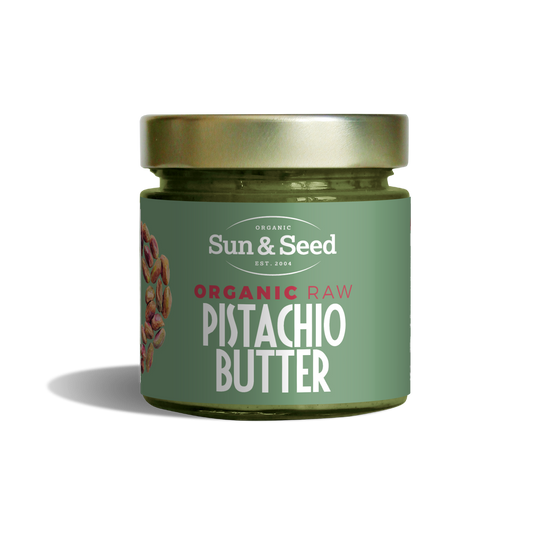
Pistachios and sweet things go together. National Geographic describes Bronte pistachios, grown in Etna's mineral-rich soil, topping Sicilian cannoli and flavouring pistachio gelato, and a pistachio sponge called delizia di pistacchio made in Palermo. Our butter is made from raw pistachios, so in a sweet dish it reads as creamy and fragrant rather than toasted. That makes it a natural fit for the same kind of dessert: ice cream, cake fillings, shortbread and custards.
Ideas
A spoonful of pistachio butter does the work of a handful of crushed nuts, with the advantage that it blends smoothly into batters, creams and sauces.
- Drizzle pistachio butter over ice cream or porridge.
- Use it in cakes, cookies and cheesecake.
- Stir into a savoury dressing with lemon juice and olive oil.
- Pair it with fruit that has some acidity, such as figs, oranges, strawberries or apricots; the sharpness lifts the sweetness.
- Fold into whipped mascarpone or thick yoghurt for a quick filling for tarts, pancakes or meringues.
- Spoon over roasted peaches or apricots with a squeeze of lemon, and finish with a few chopped whole pistachios for crunch.

Sources
- Pistachio (Pistacia vera L.) Domestication and Dispersal Out of Central Asia, Agronomy (2022)
- EUFORGEN: Pistacia vera
- UC Davis WIFSS: Pistachios
- Determination of the chlorophyll content of pistachio kernels (FAO AGRIS record)
- National Geographic: the woman behind the world's most sought-after pistachios