Sesame (Sesamum indicum) is among the oldest oilseed crops grown by people, and sesame paste is central to the cooking of the Middle East and the Eastern Mediterranean. It is a small seed with a surprisingly long story, and a few quirks that explain why it is handled the way it is.
The plant
Sesame is an erect annual plant in the family Pedaliaceae, and it has been cultivated since antiquity for its seeds. The seeds form inside capsules, and here the plant is awkward for farmers: a review of sesame research notes that mature capsules shatter and scatter their seeds on their own, a genetically controlled habit that limits production and that breeders have tried to reduce.
The seeds are rich in oil. The same review gives ranges of 44 to 57 percent oil and 18 to 25 percent protein, so a paste of ground seeds is naturally rich in oil. Seed coats come in many colours, from white and cream to brown and black. Asia and Africa grow about 97 percent of the world's sesame, according to the data that review uses.
An old crop with uncertain beginnings
Where sesame was first domesticated is still discussed. An archaeobotanical survey of African crops in South Asia concluded that sesame was probably domesticated in South Asia rather than Africa, while noting that wild relatives native to Africa may have been brought into cultivation separately. The wild progenitor of the cultivated plant is reported from the Indian subcontinent.
Written evidence is easier to follow. Bedigian and Harlan argued in 1986, from botanical and textual evidence, that a Mesopotamian oil plant long translated as flax was in fact sesame. They also record that Herodotus, writing in the fifth century BC, said sesame was the only oil used in Babylonia. Sesame was, in other words, a serious source of cooking oil long before anyone spread it on toast.
From seed to paste
A scientific study of tahini describes the usual sequence as washing, hulling, roasting, aeration and grinding. Hulling removes the seed's hull; grinding then turns the kernels into a smooth paste. The same study found that tahini made from seed with more of its hull left on came out more yellowish in colour and higher in ash, a measure of mineral content, so how much hull stays in the seed visibly changes the result.
Our tahinis are made from Bolivian sesame throughout, and the choice of seed is what separates them:
- Raw white: organic hulled white seeds, stone-ground at low temperature. 15g fibre per 100g.
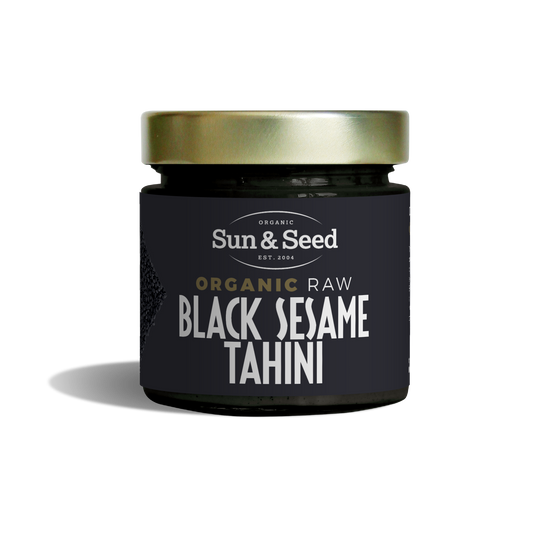
- Raw black: whole black seeds, kept raw, with a slightly stronger flavour than white. 21g protein per 100g.
- Lightly roasted: hulled white seeds, gently roasted, smooth and creamy.
- Dark roast: whole seeds with their hulls left on, giving a rich, earthy flavour with a slightly bitter undertone.
Classic dishes
Britannica describes tahini as a paste of crushed sesame seeds that is widely used in Middle Eastern cooking. Thinned with water and mixed with garlic, lemon juice and salt it becomes taratoor, which is eaten as a dip with Arab bread as part of a meze spread. Stir taratoor into ground chickpeas and you have hummus bi tahini; combine it with mashed roast aubergine and onions and you have baba ghanoush. It also turns up as a sauce for fish and vegetable dishes.
Halva belongs to the same family. Britannica describes it as a confection of Balkan and eastern Mediterranean origin, traditionally made with honey and sesame seeds (or semolina), though some versions swap in sugar and nuts.
Black sesame has its own culinary home across East Asia. In Japan it flavours ice cream and the seasoning furikake; in Chinese and Korean cooking, ground black sesame coats sweet rice cakes, and the paste fills steamed buns and tang yuan, the glutinous rice balls.
Using tahini in the kitchen
If you only know tahini from hummus, try a few other things:
- Whisk it with lemon juice and water for a sauce over roasted vegetables. It may look as if it is seizing at first; keep adding water a little at a time until it turns smooth and creamy.
- Swirl it into porridge or yoghurt.
- Stir a spoonful into brownie or cookie dough.
As with natural peanut butter, which has no added stabilisers, the natural oil rises to the top over time. That is normal and not a fault: stir it back in, or keep the jar upside down for a while and then turn it the right way up. Use within 3 months of opening and store somewhere cool and dry.
Allergens
Sesame is one of the 14 allergens that must be declared on food in the UK. Our tahinis contain sesame and may contain traces of nuts.


Sources
- Encyclopaedia Britannica: Sesame
- Yadav et al. (2022), Frontiers in Plant Science: review of sesame
- Archaeobotanical survey of African crops in South Asia (Max Planck Society repository)
- Bedigian and Harlan (1986), Economic Botany: Evidence for cultivation of sesame in the ancient world
- Effect of processing parameters on sesame paste (Turkish Journal of Agriculture, Food Science and Technology)
- Encyclopaedia Britannica: Tahini
- Encyclopaedia Britannica: Halvah
- TASTE: Black sesame in Asian cooking
- Once Upon a Chef: Tahini sauce
- Canadian Food Inspection Agency: Separation of oil in natural peanut butter
- GOV.UK: Allergen labelling for food manufacturers