Olive trees have been cultivated around the Mediterranean for thousands of years. Britannica dates the cultivated olive on Crete to about 3500 BCE, and notes that other Semitic peoples were growing it by roughly 3000 BCE. In the early 21st century Spain and Italy led world production. What changes from one bottle to the next is partly the tree and partly the date on which the fruit was picked, and that second factor is what "early harvest" is about.
 An olive is a fruit with a bitter secret
The olive (Olea europaea) is an evergreen tree, and its fruit is a drupe, the same kind of fruit as a peach or plum, with a stone at the centre. Straight from the branch it is inedible, because it contains a bitter glucoside; table olives are cured in lye or salt to remove it. For oil, however, the bitterness is part of the story.
Oil builds up in the fruit through the season. Britannica reports that oil content peaks at about 20 to 30 per cent of the fresh weight, with fruit reaching maximum weight and oil six to eight months after flowering, when it turns black. Pick earlier, while the olives are still green, and you get less oil from the same weight of fruit. That is a real cost, and it is one reason early harvest oils are a considered choice rather than a default.
 Two terms explained
- Early harvest: olives picked at the start of the season, while still green. The phrase describes timing. It is not one of the grades defined by the International Olive Council, which are things like extra virgin, virgin and refined.
- Monocultivar: oil from a single olive variety. Britannica notes that there are hundreds of named varieties, and that olives do not come true from seed, so trees are grafted or budded onto named varieties. A monocultivar oil therefore shows the character of one type of olive, much as a single-grape wine does.
Why green olives taste greener
The International Olive Council's tasting method gives precise definitions. Fruity means the aromas of sound, fresh olives, ripe or unripe. Bitter is a taste typical of oil from green olives or olives turning colour, felt on the back of the tongue. Pungent is a biting sensation, felt throughout the mouth and especially in the throat, which it describes as characteristic of oils produced at the start of the crop year, mainly from unripe olives.
The chemistry matches. A review in the journal Molecules explains that the main phenolic compounds in virgin olive oil are secoiridoids, which are linked to bitterness and pungency, with the peppery sensation attributed mainly to a compound called oleocanthal. Both are especially abundant in oils from unripe fruit and fall as the olives ripen. A Turkish study of Gemlik olives at three stages of ripeness likewise found total phenols declined as the fruit matured.
There is no single perfect picking date. A study of Italian olives concluded that there is no reliable reference parameter for optimal harvest time, and suggested that growers monitor the local microclimate to judge the ripening trend each year.
What "cold pressed" means
Under the marketing rules for olive oil retained in Great Britain, "cold extraction" may be used only for extra virgin or virgin oil obtained below 27°C by percolation or centrifugation of the olive paste. "First cold pressing" has the same temperature limit but applies to a first mechanical pressing with traditional hydraulic presses.
What is in the bottle
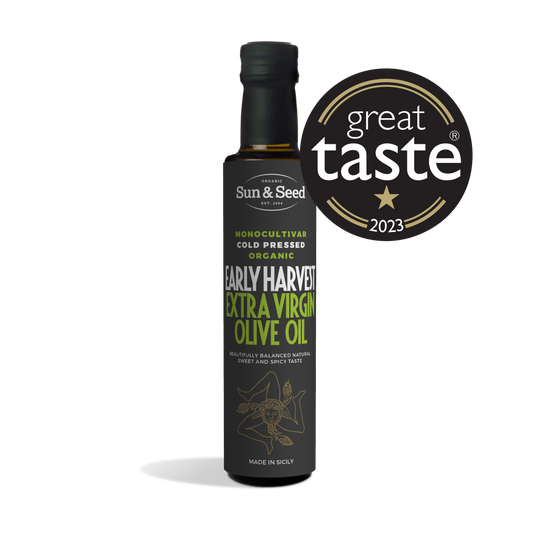
Our Premium Early Harvest Extra Virgin Olive Oil is a single-variety, cold-pressed, organic oil, made from green olives hand-picked in southern Sicily at the start of the harvest. As extra virgin oil, the International Olive Council standard requires free acidity of no more than 0.8g per 100g and a tasting panel that finds no defects and some fruitiness.
Tasting at home
Professional panels follow a set routine, and you can borrow it. The council's method keeps samples at 28°C, uses a covered glass, and asks tasters to swirl, smell for no more than 30 seconds, then take a sip of about 3ml and spread it around the whole mouth. Short breaths through the mouth help release the aromas. To judge pungency, the method says to swallow the oil.
- Pour a spoonful into a small glass, cover it and warm it in your hand for a minute or two.
- Swirl, uncover and smell. Our Great Taste judges described a grassy aroma with floral and citrus notes, so look for those.
- Sip and let it spread. Notice bitterness at the back of the tongue.
- Swallow and wait for the peppery tickle in the throat.
Try our Early Harvest Extra Virgin Olive Oil over simple food, such as bread, tomatoes or white beans, where its flavour can shine.

Sources
- Encyclopaedia Britannica: Olive
- International Olive Council: Olive oil categories
- International Olive Council: Sensory analysis of olive oil (COI/T.20/Doc. No 15)
- International Olive Council: Trade standard applying to olive oils
- Bendini et al., Molecules 2007: Phenolic molecules in virgin olive oils
- Çevik et al., Acta Alimentaria 2014: Effect of harvest time on extra virgin olive oil
- Rotondi and Lercker, Acta Horticulturae 2002: Influence of olive ripening degree on the composition and stability of olive oil
- legislation.gov.uk: Implementing Regulation (EU) No 29/2012, Article 5