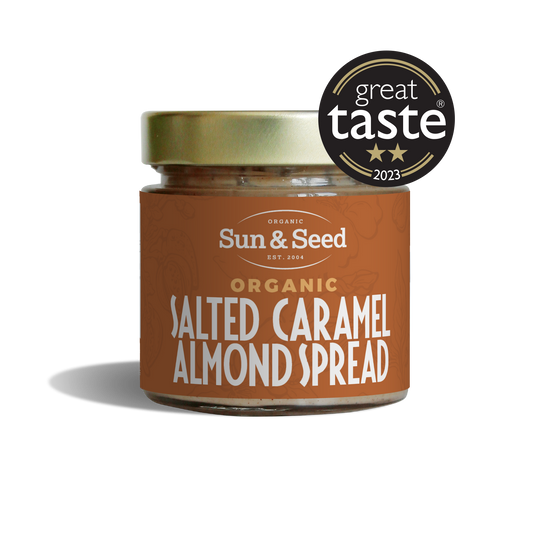
Both of these spreads are made without refined sugar and without dairy, but they are very different jars. One is a chocolatey, crunchy spread built on hazelnuts and cacao; the other is a silky almond cream with a caramel-fudge warmth. Before we help you choose, here is a little about where the main ingredients come from.
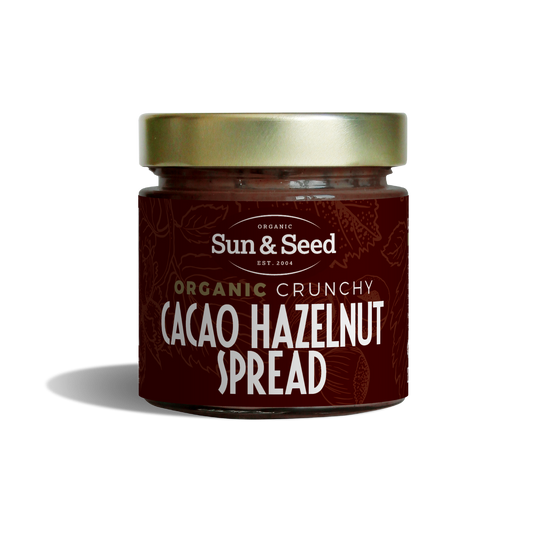
Organic Crunchy Cacao and Hazelnut Spread
This spread is made from organic cashews, coconut sugar, hazelnuts, cacao powder, lucuma and coconut oil, with 54% hazelnuts and cashews. It is stone-ground into a creamy, smooth spread, with finely chopped hazelnut pieces left in for crunch. It is dairy-free and sweetened with coconut sugar rather than refined sugar.
Where the ingredients come from.
- Hazelnuts have their origins in the centre of Anatolia, according to the FAO, and Turkey is still the world's leading producer, at roughly 73% of total world supply.
- Cacao has Mesoamerican roots. History.com traces chocolate to the Olmecs of southern Mexico, with vessels from about 1500 BCE containing theobromine, and to the Maya, who drank it thick and frothy, sometimes with chilli peppers or honey. The Aztecs called it xocolatl. Cacao powder as we know it is more recent: in 1828 the Dutch chemist Coenraad van Houten developed a press that separated cocoa butter from roasted beans, which made powdered cocoa cheap and easy to produce.
- Lucuma is an evergreen tree native to the Andean valleys, and one ingredient supplier calls it the "Gold of the Incas". It describes the pulp as tasting like a mix of maple syrup, caramel and sweet potato, which is why it can lend a gentle sweetness.
- Coconut sugar is produced from the sap of the cut flower buds of the coconut palm, as the Asian and Pacific Coconut Community describes it.
Use it on: pancakes, toast and waffles, stirred into porridge, overnight oats or smoothies, drizzled over brownies or ice cream, or straight from the spoon.
Organic Salted Caramel Almond Spread
The salted caramel almond spread is a limited edition and a Great Taste award winner. It is made from 90% organic blanched almonds stone-milled into a velvety cream, sweetened with organic date syrup and finished with a pinch of Himalayan salt. The flavour sits somewhere between caramel fudge and almond cream: rich, smooth and lightly toasty, with a texture that is silky enough to drizzle and thick enough to spread.
The Great Taste Awards are run by the Guild of Fine Food. Every entry is tasted completely blind, so judges see neither the packaging nor the producer, and products earn one, two or three stars. In 2025 the awards drew a record 14,340 entries from 110 countries, judged by more than 500 food experts including chefs, critics and retailers.
Use it on: toast, waffles and crumpets, swirled into yoghurt, chia pudding or smoothies, drizzled over pancakes, fruit, brownies or ice cream, or stirred into hot chocolate or coffee.
The figures side by side
Here is what the product labels say, per 100g.
- Cacao and hazelnut: 2250kJ / 541kcal; fat 36g (saturates 11g); carbohydrate 41g (sugars 30g); fibre 4.9g; protein 11g; salt 0.06g.
- Salted caramel almond: 576kcal; fat 49.2g (saturates 3.76g); carbohydrate 13.5g (sugars 10.4g); fibre 6.8g; protein 18.9g; salt 0.50g.
The difference mostly follows the recipes. The cacao spread is built on cashews, coconut sugar and cacao, so more of the jar is carbohydrate. The almond spread is 90% almonds, so more of it is fat and protein.
Which one?
- Want something chocolatey with crunch? The cacao and hazelnut.
- Want something silky with caramel warmth? The salted caramel almond.
- Cannot decide? Keep one of each.
Try them in our cacao hazelnut and caramel overnight oats.
Good to know
Oil separation is natural, so stir before enjoying. Store in a cool, dry place and use within 3 months of opening. Both may contain traces of other nuts and sesame. Gluten, dairy and soy free. Suitable for vegans and vegetarians.