The almond (Prunus dulcis) is a tree of the rose family, and the part we eat is its seed. It has a long history with people, and this is how a plant from south-west Asia ended up in a jar of butter.
Where almonds come from
Britannica gives the almond's native home as south-western Asia. A 2023 paper in Frontiers in Plant Science places its domestication in the Fertile Crescent about 12,000 years ago, and describes it as a matter of selecting sweet-kernel mutants. That detail matters. Wild almonds are bitter because the kernel accumulates a compound called amygdalin; sweet cultivars carry only trace amounts. Food scientists at UC Davis report that non-bitter varieties average about 63mg of amygdalin per kilogram, against about 40,060mg/kg in bitter ones. The UK Food Standards Agency has noted that bitter almonds are known to have high cyanide levels and are normally used only after further processing or home cooking, not eaten raw. Sweet almonds are the ones grown and sold for eating.
Britannica adds that almonds are grown primarily in Mediterranean climates. Climate is a recurring theme in the tree's story: it was the cool, moist weather in California that held back the first plantings there, as the next section explains.
Travelling west
Almonds turn up early in written tradition: the Almond Board of California's history page points to the Book of Numbers, where Aaron's rod blossoms and bears almonds, and to Greek myth. It says that by Roman times newlyweds were showered with almonds as a fertility charm. The same source records that Franciscan padres brought the tree from Spain to California in the 1700s, but cool, moist weather delayed success until the following century. California now grows roughly 80% of the world's almonds.
Sicily and the Mediterranean tradition
Our toasted almond butter uses organic almonds grown in Sicily. National Geographic's report from Avola, in the south-east of the island, describes a long tradition: one local producer calls the almond tree probably one of the first crops introduced by conquerors of the Sicilian coast, and credits Arab irrigation techniques with the quality of the crop. The Avola almonds are harvested by hand between July and September by gently shaking the branches, then hulled and sun-dried. Much of the harvest goes into marzipan, cassata and sugared almonds. We cannot say which variety is in our jar, so treat Avola as a picture of the tradition rather than a description of our supplier.
A year in the orchard
The Almond Board's calendar describes California, and timings differ elsewhere, but it shows the stages every almond goes through:
- Trees are dormant over winter, then open white and light-pink flowers from mid-February to mid-March.
- Honey bees carry the pollen between varieties. UC Agriculture and Natural Resources notes that California orchards need about two beehives per acre.
- From March to June the kernel matures and the shell hardens inside a fuzzy hull.
- In July the hull splits, exposing the shell so the nut can dry.
- From August to October machines shake the nuts to the ground, where they dry for 7 to 10 days before being collected. A huller removes the hull and shell.
An almond is therefore a seed wrapped in a shell, wrapped in a hull, and it arrives at the factory only after all that.
Raw or toasted
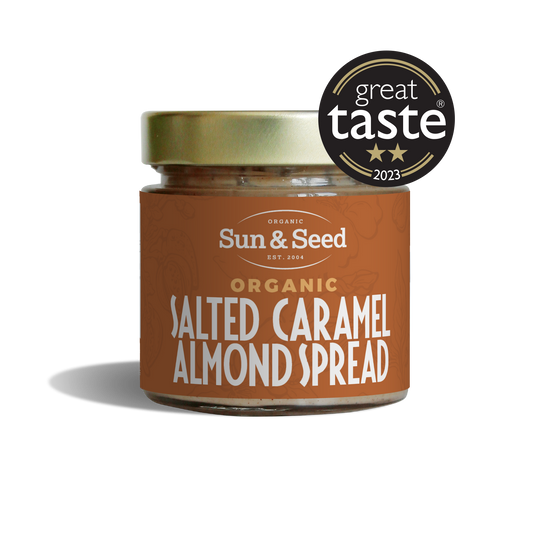
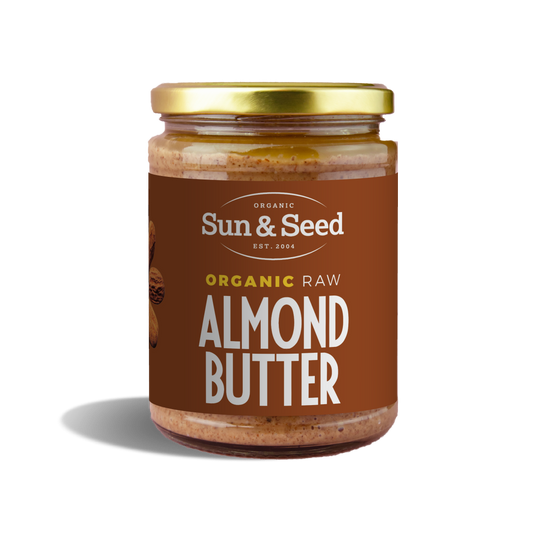
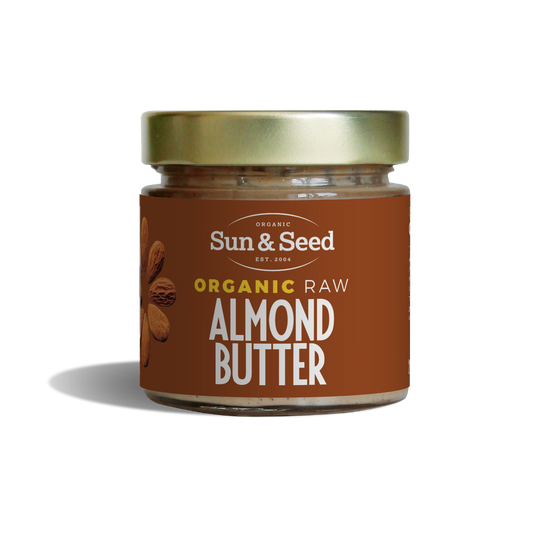
Our raw almond butter uses organic raw almonds grown in Europe, ground with artisan techniques. Our toasted almond butter is made from organic almonds grown in Sicily, and has a deeper, roasted flavour.
The flavour difference has a clear chemical basis. UC Davis researchers describe the aroma of raw almonds as generally faint, apart from benzaldehyde, the compound behind the marzipan and amaretto note. Roasting, which is commonly done at 130 to 150°C for almonds, sets off the Maillard reaction and sugar breakdown, creating compounds such as pyrazines and furans that read as malty, roasted, chocolatey and nutty. The same work found those roasted notes fade in storage, with significant losses by two months, which fits with our advice to use a jar within 3 months of opening.
In the kitchen
Almond butter spreads on toast, melts into fudge, whisks into dressings and turns into protein balls. It has 24g of protein per 100g. If you like to cook with it, try the almond butter fudge or the almond butter and sprouted oats protein bars.


Sources
- Almond (Encyclopaedia Britannica)
- Lotti et al., sweet kernel alleles in almond germplasm (Frontiers in Plant Science, 2023)
- Understanding the chemistry of almond flavor (UC Davis / Almond Board of California)
- Letter to food business operators on cyanide in kernels (Food Standards Agency, 2017)
- Almond global history (Almond Board of California)
- Almond harvesting in Avola, Italy (National Geographic)
- The almond lifecycle (Almond Board of California)
- Almond pollination and honey bees (UC Agriculture and Natural Resources)