The common walnut (Juglans regia) is one of the oldest cultivated food trees in the world. It is also called the Persian walnut or the English walnut, depending on who you ask, and the names tell you something: this is a tree that has been carried a very long way from wherever it started.
Where it comes from
Pinning down a native range is harder than it sounds. The walnut has been planted for so long that wild and cultivated populations have mixed. EUFORGEN, the European forest genetic resources programme, says the tree is believed to have originated in the Mediterranean region and Central Asia, while Britannica gives its native range as Iran.
What the evidence does show is that walnut survived the last ice age in Europe rather than being reintroduced afterwards. A 2017 study in PLOS ONE combined fossil pollen with the genetics of living trees and found support for refuges in Anatolia, the Balkans and western Europe. Walnut pollen appears early in the present warm period at sites in Turkey, North Macedonia, Greece and Bulgaria.
How people spread it
The same study dates the start of human-mediated mixing between Anatolian and Balkan walnuts to the Early Bronze Age, roughly 4,100 to 5,600 years ago. Pollen records rise sharply from about 2,500 years ago, which the authors link to cultivation in Greek and Roman times. Walnuts were part of Roman agro-forestry, grown for both fruit and timber, and the authors tie the later mixing of western European and Balkan trees to Roman overland routes. The authors are careful to say their dates are estimates and should be treated with caution.
The English word itself records the journey. According to the Online Etymology Dictionary, Old English walhnutu meant "foreign nut": wealh was the word for a foreigner, and the nut was the one that came from Gaul and Italy, as opposed to the native hazel. The same root gave us the word Welsh.
A tree, a husk and a seed
A walnut is not a true nut. Britannica describes the fruit as a drupe: the edible seed sits inside a woody pit, which is enclosed in a thick husk. The tree bears male and female flowers separately on the same tree, in different catkins, and EUFORGEN notes it is wind-pollinated. It is a large, long-lived deciduous tree with long compound leaves, and its dark, fine-grained wood has long been used for furniture and panelling.
Why walnuts can taste bitter
Anyone who has bitten into an old walnut knows the dry, puckering bitterness it can have. Much of that comes from tannins. A study in the Journal of the Science of Food and Agriculture measured tannins in walnuts after different treatments and found that astringency scores in blanched walnuts rose and fell with tannin content. It also found that blanching or soaking in alkali sharply reduced extractable tannins, and that storing walnuts for 21 days at 25°C reduced them by 20 to 40 per cent.
Our activated walnuts are soaked in salted water and then dried, which gives a crisp, lightly savoury result. We make no claim about what the soak removes; the research above simply explains why the treatment of the kernel changes how a walnut tastes.
Freshness matters
Walnut kernels are rich in polyunsaturated fat, and that makes them more prone to going stale than most nuts. A 2021 study in the journal Foods followed two walnut cultivars in storage and found that the oxidative stability of both the kernels and their oil fell significantly over time. In practice: buy walnuts in modest quantities, keep them in a sealed container somewhere cool and dark, and if a walnut tastes sharp, harsh or stale, it is past its best.
Kitchen ideas
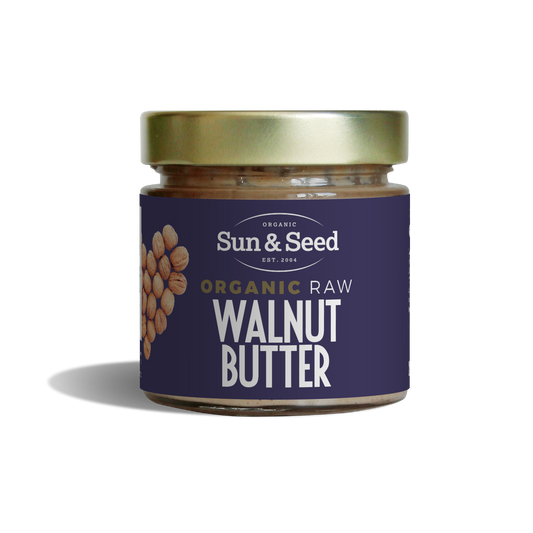
- Stir walnut butter into oats with honey or maple.
- Chop activated walnuts into salads, with pears and blue cheese; the sweetness of the fruit and the saltiness of the cheese soften walnut's bitter edge.
- Toast whole walnuts briefly in a dry pan, then chop them over roasted carrots or squash. Watch the pan closely and take the nuts off as soon as they smell fragrant, because oily nuts darken quickly.
- Pair with pears, apples, beetroot, dark chocolate or coffee; all of them stand up to walnut's character.
- Bake into banana bread or brownies.
- Pound walnuts with garlic, olive oil and a little lemon for a rough sauce to toss through pasta.


Sources
- EUFORGEN: Juglans regia
- Britannica: Persian walnut
- Rethinking the history of common walnut (Juglans regia L.) in Europe, PLOS ONE (2017)
- Online Etymology Dictionary: walnut
- Effects of processing and storage on walnut tannins (J Sci Food Agric, 2001)
- Walnut volatile compounds indicate kernel and oil oxidation, Foods (2021)